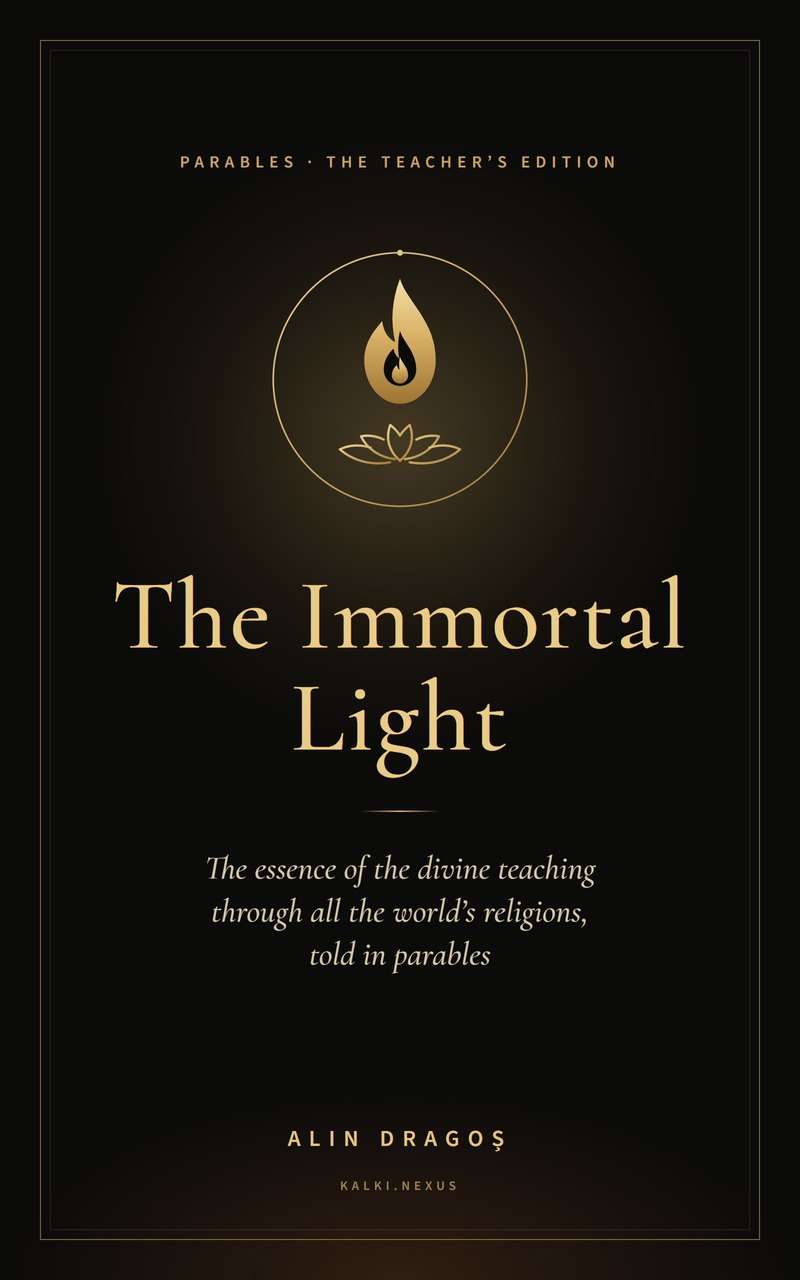
Cover of the book “The Immortal Light”, by Alin Dragoș

Parables

The Immortal Light

The Teacher's Edition · 55 parables

Alin Dragoș · 201 pages · PDF · English

Fifty-five parables from the world's traditions, from Gilgamesh and the Upanishads to the Gospels, the Talmud, Rumi and Zhuangzi, retold in the author's own prose and arranged around eight themes: God, love, suffering, consciousness, death, the path, the inner light and the synthesis.

The digital edition (PDF) will be available for purchase here soon. Until then, read the beginning for free.

Read the beginning for free
“A copied story is a dead story: to live, it has to pass through someone, and whoever it passes through leaves marks on it.”
“If you close the book believing exactly what you believed when you opened it, but with one more window in the wall, then it has done its work.”
“I am not writing this from above. I am writing from the same kitchen. The book was easier to write than it is to live, and anyone who says otherwise is lying.”

About the book

The Immortal Light sets the great religious traditions of the world side by side and lets each of them speak in turn about the things that cannot be avoided: God, love, suffering, consciousness, death. It does not compare them in order to choose one, and it does not blend them into a single teaching. The differences stay where they are; the book listens for what can be heard beyond them.

Most of the book is parables: fifty-five old stories, from the Epic of Gilgamesh, the Upanishads, the Buddhist canon, the Gospels, the Desert Fathers, the Quran and the hadith, the Talmud, Rumi, Zhuangzi and others, retold in the author's own prose from texts in the public domain. Each parable is followed by a short page, "What the parable knows", in which the author says what he sees in the story, with the request that, whenever the story says something else, you believe the story.

The eight chapters share one shape: an opening of the theme, the voices of the traditions, each with its parable, and a synthesis that ends in a single sentence. The chapter on the path adds, for prayer, meditation, the service of others and study, one simple exercise each, to be begun the next morning. The epilogue returns to ordinary life and to what remains after you close the book.

The author says from the start where he speaks from, the Eastern Christianity he was born into, and that he did not write the book to move anyone from one faith to another. At the end there is the complete list of the parables, with the old text from which each one comes.

Who it is for

For those who seek, whatever name they give the divine and whatever language they pray in. For readers who want to know the great traditions through their stories, not through treatises. For parents, teachers and anyone who needs parables to pass on.

Contents

  1. Foreword

    To the Reader Who Opened This Book Without Yet Knowing Why

    Why a book about religions told in parables, what the book does not do, and where the author speaks from.

  2. Introduction

    One from Many — Many from One

    The question of what lies beyond, the five bones shared by every living path, the parable of Gilgamesh and the parable of the old road in the forest.

  3. Chapter I

    God — The Faces of the Infinite

    Six traditions on ultimate Reality, from Brahman to the Tao, closing with the parable of the blind men and the elephant.

  4. Chapter II

    Love — The Force That Moves the Stars

    Agape, the mercy that has a womb, bhakti, metta, the love that does not lay a hand, and ubuntu: six ways of stepping out of the center.

  5. Chapter III

    Suffering — The Fire That Purifies

    Five answers that refuse both "you deserved it" and "it means nothing", and look at suffering as a threshold.

  6. Chapter IV

    Consciousness — The Mystery at the Center of Existence

    Advaita, the Buddhist teaching of non-self, gnosis and hesychasm, and the eye that cannot see itself.

  7. Chapter V

    Death — The Great Gate

    Six answers to the same question, and Zhuangzi drumming on the tub on the day he was supposed to mourn.

  8. Chapter VI

    The Path — The Practice of Transformation

    Prayer, meditation, service and study, each with its parable and with an exercise for the next morning.

  9. Chapter VII

    The Inner Light — The Spark That Never Goes Out

    The apophatic way, illumination as recognition, and the light that cannot be seen by looking at it directly.

  10. Chapter VIII

    The Synthesis — One Message, a Thousand Voices

    Seven shared pillars and the essential message in five sentences, without smoothing over the differences between traditions.

  11. Epilogue

    The Return Home

    What remains after you close the book, and the parable of the dog at the gate.

  12. Appendix

    The Parables and Their Sources

    The list of the fifty-five parables, with the old text from which each one is retold.

The digital edition (PDF) will be available for purchase here soon. Until then, read the beginning for free.

Read the beginning for free